
3D printed ABS parts are popular due to their strength, durability, versatility, and affordability, making them ideal for various applications.
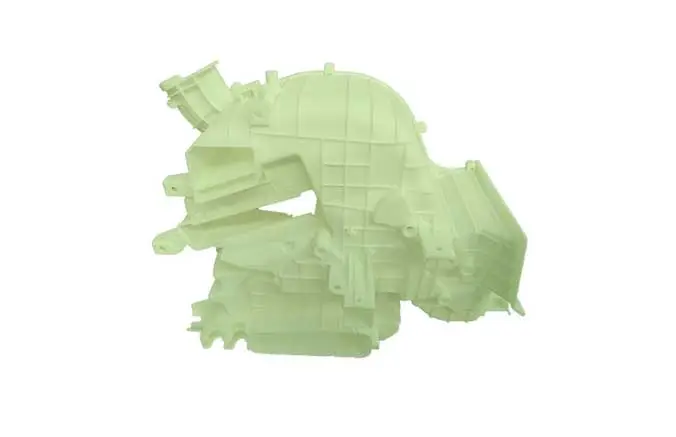
Strong, durable ABS plastic is a widely used FDM 3D printing material due to its material properties and capabilities for prototyping functional models, tooling, fixtures, and end-use components.
| Guideline | Description |
| Layer Height | Choose optimal layer height for desired surface finish. |
| Wall Thickness | Maintain appropriate thickness for structural integrity. |
| Overhangs and Bridges | Design overhangs within the printer's capabilities or add supports. |
| Print Orientation | Select orientation to minimize supports and achieve strength. |
| Cooling and Warping | Use cooling settings to reduce warping and improve accuracy. |
| Raft or Brim | Add a raft or brim to improve adhesion and prevent warping. |
| Material Selection | Choose ABS filament for its strength and temperature resistance. |
| Fillet and Chamfer | Add fillets and chamfers to reduce stress concentrations. |
| Hole Sizes | Account for material shrinkage when designing holes. |
| Tolerances | Design parts with accurate tolerances for fit and function. |
| Property | ABS | ABS+PC Blend |
| Tensile Strength (MPa) | 40 - 50 | 55 - 70 |
| Flexural Strength (MPa) | 55 - 75 | 70 - 85 |
| Impact Strength (J/m) | 200 - 400 | 350 - 600 |
| Hardness (Rockwell R) | 90 | 100 |
| Density (g/cm³) | 1.04 - 1.07 | 1.08 - 1.20 |
| Notched Izod Impact (J/m) | 200 - 400 | 200 - 400 |
| Heat Deflection Temperature (°C) | 80 - 105 | 90 - 130 |
| Melt Temperature (°C) | 210 - 280 | 240 - 290 |
| Flame Resistance | UL 94 V-0 | UL 94 V-0 |
| Chemical Resistance | Good | Good |

ABS 3D printing produces impact-resistant prototyping and end-use parts with good dimensional stability. Applicable for concept models, fixtures, enclosures, and durable components across automotive, consumer goods, electronics and various industries.
 English